In the early days of the generative AI boom, launching a profitable AI tool required little more than a basic understanding of React and an OpenAI API key. Thousands of software as a service (SaaS) businesses were built on the exact same architecture: a frontend text input, a backend function that forwarded that text to a Large Language Model (LLM), and a loading spinner that made the user wait while the API generated a response. This era of the “API Wrapper” is officially dead.
Today’s users expect telepathic responsiveness. They do not tolerate loading spinners, and they expect artificial intelligence to output more than just markdown text. They expect the AI to generate dynamic, interactive user interfaces in real-time. To survive in the modern landscape of AI tools, developers must abandon traditional REST APIs and embrace the architecture of AI-Native applications: Serverless Streaming and Generative UI.
The Mathematics of Perceived Latency
The fundamental flaw of the traditional API wrapper is how it handles latency. When you make a standard synchronous HTTP request to an LLM for a 1,000-word essay, the model must generate all 1,000 words before the server can send a 200 OK response back to the client. This can take upwards of fifteen seconds. In web development, a fifteen-second wait time translates to catastrophic bounce rates.
To solve this, AI-native applications focus entirely on optimizing Perceived Latency rather than absolute completion time. The mathematical model for user experience in generative AI is defined by two metrics: Time To First Token (TTFT) and Time Per Token (TPT). The total perceived wait time for the user before the interface starts reacting is purely the TTFT:
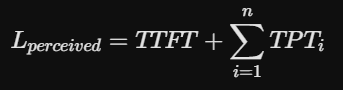
If you can drive your TTFT down to under 400 milliseconds, the user perceives the application as instantaneous, even if the total summation of $TPT_i$ (the time it takes to generate the rest of the text) takes ten seconds. The user is actively reading the stream, effectively masking the processing time.
Achieving this requires abandoning traditional REST architecture and implementing Server-Sent Events (SSE).
Bypassing WebSockets: The Power of Server-Sent Events
When developers realize they need real-time streaming, their first instinct is often to build a bidirectional WebSocket infrastructure. For AI text generation, this is an architectural anti-pattern. WebSockets require constant connection maintenance, heartbeat pings, and massive server overhead to keep the socket alive.
AI generation is inherently a unidirectional data flow. The client sends a single prompt, and the server streams back a massive payload of tokens. This makes Server-Sent Events (SSE) the optimal protocol. SSE operates over standard HTTP, meaning it requires no specialized server configuration and perfectly traverses corporate firewalls.
When you utilize frameworks like the Vercel AI SDK alongside Edge computing, the architecture becomes ruthlessly efficient. The user submits a prompt, the Edge function intercepts it globally within milliseconds, initiates the SSE connection, and pipes the LLM’s raw output directly into the client’s React state as fast as the tokens are generated. The loading spinner is eradicated.
Generative UI: Moving Beyond Plain Text
Streaming text is only the baseline requirement. The true frontier of AI tools is Generative UI.
If a user asks an AI financial tool, “How did Tesla’s stock perform this week?”, an API wrapper will return a paragraph of text explaining the stock price. An AI-native application, however, will not return plain text. It will return a fully interactive, D3.js-powered candlestick chart that the user can hover over and manipulate.
This is achieved by moving away from prompting LLMs for conversational answers and instead utilizing strict Function Calling and structured JSON outputs.
In a Generative UI architecture, the LLM acts as a silent orchestration layer. When the user asks about the stock, the LLM analyzes the intent, realizes it needs visual data, and outputs a specifically formatted JSON payload containing the ticker symbol and the historical data points. Your frontend framework intercepts this JSON stream in real-time, bypasses the text renderer, and instantly mounts a React <Chart /> component directly into the chat interface.
The AI is no longer just a writer; it is a real-time frontend developer, dynamically assembling the application’s interface based on the exact context of the user’s current query.
The Edge Compute Imperative
Executing this level of dynamic streaming requires a fundamental shift in where our backend logic is hosted. Traditional serverless functions (like standard AWS Lambda or Node.js instances) suffer from “cold starts”—the time it takes the cloud provider to boot up the server before it can even begin processing the request. A two-second cold start destroys the 400-millisecond $TTFT$ goal before the LLM even sees the prompt.
AI-native applications must be deployed to the Edge. Edge functions utilize V8 isolates instead of full Node.js containers, meaning they boot in less than 10 milliseconds. By distributing these lightweight streaming proxies globally, you ensure that a user in Tokyo is connecting to a streaming endpoint in Tokyo, rather than waiting for a TCP handshake to cross the Pacific Ocean to a server in Virginia.
The era of the weekend API wrapper is over, but the opportunity for deeply engineered AI tools has never been greater. By mastering edge streaming, optimizing token latency, and building dynamic Generative UIs, you are not just wrapping an AI; you are building an intelligent, native software ecosystem.