
The modern knowledge worker is operating under a fatal delusion. We purchase every new Artificial Intelligence subscription, integrate large language models into our IDEs, and automate our task managers, expecting an exponential increase in our daily output. Yet, at the end of a ten-hour workday, the overwhelming sensation is not one of extreme throughput, but of cognitive exhaustion and minimal tangible progress.
Why does adding faster processing tools not automatically result in faster completion times?
The answer lies in a fundamental misunderstanding of systems architecture. We are attempting to treat the human brain like a multi-core, parallel-processing server cluster. In reality, the human mind is a strictly single-threaded CPU with a highly limited RAM capacity. When you introduce dozens of high-speed AI tools and real-time communication channels into a single-threaded environment, you do not increase throughput; you induce a state of catastrophic system thrashing.
To truly master productivity in the AI era, we must stop reading self-help books and start studying computer science. By applying CPU scheduling algorithms and mathematical models to our daily workflows, we can build a zero-friction environment that actually leverages AI to scale human output.
The Mathematics of Cognitive Thrashing
In operating system design, “thrashing” occurs when a computer’s virtual memory subsystem is in a constant state of paging, rapidly exchanging data in memory for data on disk. The system spends more CPU cycles swapping memory than executing actual application-level processes.
This is exactly what happens when you attempt to multitask between writing code, answering Slack messages, and prompting an AI assistant.
Every time you shift your attention from a primary deep-work task to an interruption, you incur a Context-Switching Penalty. Let us represent the total time required to complete a set of tasks as the sum of the time required for each individual task, plus the penalty of switching between them:
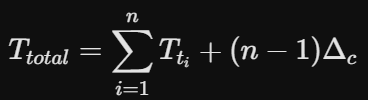
In a microprocessor, $\Delta_c$ is measured in nanoseconds. In the human brain, cognitive science research dictates that it takes an average of 23 minutes and 15 seconds to fully rebuild the mental context of a complex task after an interruption.
If your workflow forces you to check a notification or switch applications just five times during a coding session ($n=5$), your mathematical output collapses. You have instantly lost over an hour and a half strictly to $\Delta_c$, regardless of how fast your AI can generate boilerplate code. To optimize productivity, your primary architectural goal must be driving $n$ as close to 1 as possible.
Amdahl’s Law and the AI Speedup Delusion
The second architectural fallacy is overestimating the impact of AI on our total workflow. Developers frequently boast that a generative AI tool has made them “10x faster.” This assumes that because a specific task (typing code) is accelerated, the entire job is accelerated equally.
This violates Amdahl’s Law, a formula used in computer science to find the maximum expected improvement to an overall system when only a part of the system is improved. The formula is defined as:
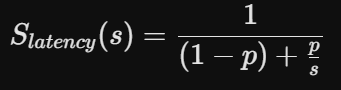
Where:
- S_{latency} is the theoretical speedup of the execution of the whole task.
- s is the speedup of the part of the task that benefits from improved system resources (e.g., using AI to write code 100 times faster, so $s = 100$).
- p is the proportion of execution time that the part benefiting from improved resources originally occupied.
- (1-p) is the strictly sequential portion of the task that cannot be accelerated by the new tool (e.g., meetings, system design, debugging hallucinations, client communication).
Let us apply this to a software engineer. Suppose writing boilerplate code previously took 40% of your week (p = 0.40). You adopt an advanced AI coding assistant that speeds up this specific task by an incredible factor of 100 ($s = 100$).
Plug those numbers into Amdahl’s Law:

Despite having a tool that writes code 100 times faster, your absolute maximum theoretical productivity increase for the week is only 1.65x.
Why? Because the un-optimizable, sequential portion of your job ((1-p), the remaining 60%) dictates the hard limit of your throughput. If you want to achieve true 10x productivity, you cannot just buy a faster AI code generator. You must aggressively attack and reduce the sequential bottleneck: the administrative overhead, the meetings, and the communication loops.
Architecting the Zero-Friction Environment
Knowing the mathematics of our limitations, how do we architect an environment that maximizes our single-threaded capacity? We must treat the human brain as the central processor, and use AI tools as asynchronous background “Daemons” to handle all Input/Output (I/O) requests.
1. Asynchronous I/O Offloading
An operating system never pauses the main CPU to wait for a user to type on a keyboard; it uses interrupts and buffer memory. You must do the same with your communication.
Never read emails, Slack messages, or project management updates sequentially as they arrive. This artificially inflates your context-switching penalty. Instead, deploy AI automation tools (like n8n or Zapier connected to an LLM) to act as your I/O buffer. Have the AI intercept every incoming message, extract the actionable data, categorize it by urgency, and hold it in a database.
2. Scheduled Cron Jobs for Human Processing
Once you have buffered your interruptions, you process them exactly like a server processes background tasks: via scheduled Cron Jobs.
Instead of an open Slack window, configure your AI automation to compile a single, highly structured brief of all daily communications. Schedule this brief to be delivered to you exactly twice a day (e.g., at 11:30 AM and 4:30 PM). By batching all your sequential communication tasks into two designated time blocks, you force the (1-p) variable in Amdahl’s Law to shrink, unlocking higher overall speedups.
3. The 120-Minute Core Thread
With the I/O handled asynchronously, your primary CPU (your focused attention) is now isolated and protected.
The ultimate productivity hack in 2026 is not a new application; it is the discipline to execute a 120-minute uninterrupted block of deep work. During this block, all network interfaces are mathematically severed. Notifications are disabled at the OS level. The browser is restricted to local documentation. You load the entire architecture of the problem into your biological RAM, and you execute.
When you combine a zero-interruption environment with the execution speed of AI-assisted tools, you finally bypass the bottleneck. You stop thrashing.
The Shift from Typist to System Architect
The era of measuring productivity by lines of code written, words typed, or emails answered is definitively over. Artificial intelligence has commoditized raw execution speed.
The professionals who will dominate the next decade are those who recognize their own biological limitations. They do not fight against their single-threaded nature; they design around it. They use AI not merely to type faster, but to build protective layers around their cognitive resources.
In this new paradigm, your value is not determined by how well you can multitask. It is determined by your ability to ruthlessly eliminate context switching, calculate the true bottlenecks in your workflow, and architect an environment where your mind is free to do the one thing AI still cannot: engage in deep, unbroken, creative problem-solving.